Why AI Pilots Remain Pilots
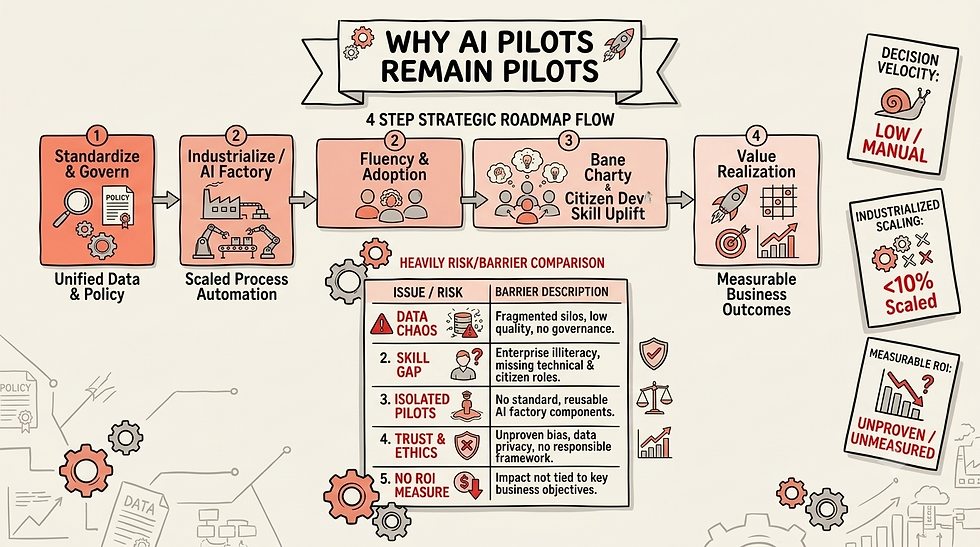
The Hidden Operating Model Problem Behind Enterprise AI Failure
Artificial intelligence has largely passed the proof-of-concept stage.
Few executives today question whether AI can generate content, automate tasks, accelerate software development, improve customer interactions, or enhance employee productivity. The technology has demonstrated its potential across virtually every business function.
Yet a paradox continues to define enterprise AI.
Organizations everywhere can point to successful pilots.
Far fewer can point to enterprise transformation.
For every celebrated AI success story, there are dozens of pilots that never move beyond their initial scope. They generate excitement, demonstrate promise, and produce localized gains. Then they stall.
The technology works.
The transformation does not.
The reason is that most organizations misunderstand the challenge they are trying to solve.
Scaling AI is not primarily a technology problem.
It is an organizational capability problem.
The Enterprise Pilot Graveyard
Across every industry, executives encounter a familiar pattern.
A business unit launches an AI initiative. Results appear promising. Productivity improves. Cycle times shrink. Employees embrace the solution. Leaders approve the pilot as a success.
The expectation is that success will naturally spread across the enterprise.
Instead, momentum slows.
Months later, the pilot continues to exist, but scale remains elusive.
Additional use cases emerge, each managed independently. New teams begin separate experiments. Different tools enter the environment. Governance discussions intensify. Questions about ownership, support, compliance, and measurement start to surface.
The organization accumulates pilots rather than capabilities.
Over time, a growing portfolio of successful experiments creates the impression of progress while enterprise transformation remains largely unchanged.
This pattern is not uncommon. In fact, it is becoming the defining challenge of the current AI era.
The question facing CIOs is no longer whether AI works.
The question is why organizations struggle to make it work repeatedly and at scale.
The Misconception at the Heart of AI Transformation
Most AI initiatives begin with a technology objective.
The goal is to prove that a model can perform a task, automate a process, improve decision-making, or augment employee productivity.
Pilots are therefore designed to answer a technical question:
Can this solution work?
In most cases, the answer is yes.
The challenge emerges when leaders attempt to answer a different question:
Can this capability scale across the enterprise?
The second question is not technical. It is operational.
Scaling introduces complexity that rarely appears during pilot phases. Governance must be embedded. Workforce adoption must be accelerated. Delivery mechanisms must become repeatable. Business outcomes must become measurable. Risk management must be institutionalized.
Many organizations discover that although they built a successful solution, they never built a system for replicating success.
That is where scaling begins to fail.
Five Reasons AI Pilots Don't Scale
1. No Standardized Access
The first barrier to scale is fragmentation.
In many organizations, teams independently select tools, experiment with different approaches, and develop localized delivery models. What begins as innovation eventually creates inconsistency.
Employees experience different capabilities depending on their function. Support structures vary. Knowledge sharing becomes difficult.
The enterprise never develops a common foundation for adoption.
As a result, successful pilots remain confined to individual teams because the organization lacks a consistent mechanism for scaling access.
The problem is not availability of technology. The problem is the absence of an enterprise access strategy.
2. Governance Arrives Too Late
Many organizations treat governance as a compliance activity rather than a scaling enabler.
During pilot phases, speed is often prioritized over structure. Teams focus on proving feasibility while governance discussions are deferred until solutions demonstrate value.
This approach creates predictable challenges.
Questions around data protection, responsible AI, accountability, security, and regulatory compliance emerge after deployment has begun. Governance teams become involved late in the lifecycle.
Expansion slows while controls are established retroactively.
Organizations frequently interpret governance as an obstacle to innovation.
In reality, governance is one of the prerequisites for scale.
Without trust, adoption slows. Without trust, enterprise deployment becomes difficult. Without trust, executive confidence declines.
Successful organizations design governance into delivery from the beginning rather than adding it later.
3. No Production Factory
The third scaling challenge is the tendency to treat every AI initiative as a unique project.
Many enterprises develop pilots independently. Different teams create different architectures, delivery methods, implementation approaches, and support models.
This is sustainable when there are five pilots.
It becomes unsustainable when there are hundreds.
Without standardization, AI delivery remains artisanal rather than industrialized.
Every implementation requires significant effort. Lessons learned are not systematically reused. Knowledge remains localized. Development cycles become longer than necessary.
Organizations that scale AI successfully eventually create what can best be described as an AI factory - a repeatable production system capable of consistently turning ideas into deployed capabilities.
Without that factory, scaling becomes expensive, slow, and unpredictable.
4. People Are Trained but Not Transformed
Perhaps the most underestimated challenge in enterprise AI is human behavior.
Many organizations invest heavily in training programs. Thousands of employees complete educational modules and workshops. Certification rates increase.
Yet transformation remains limited.
The reason is simple.
Training creates awareness. Transformation changes behavior.
Employees must learn not only how AI works but also how work itself should change. New habits must form. New ways of collaborating must emerge. Managers must lead differently. Teams must incorporate AI into everyday workflows.
This requires communities, champions, change networks, leadership engagement, and sustained enablement.
Enterprise adoption is fundamentally a people challenge.
Organizations that overlook this reality often discover that training completion rates rise while actual behavioral change remains modest.
5. Value Is Anecdotal
The final barrier to scale is the inability to measure outcomes consistently.
Most organizations can collect success stories.
Employees report productivity gains. Leaders highlight positive examples. Teams describe reductions in manual effort.
While encouraging, anecdotal evidence rarely supports enterprise investment decisions.
Boards and executive committees require a different level of visibility.
They need to understand productivity impact, efficiency improvements, business outcomes, risk reduction, revenue contribution, and organizational performance.
Without enterprise telemetry, AI remains difficult to manage strategically.
Leaders struggle to determine which initiatives deserve further investment, which should be scaled, and where value is truly being created.
Measurement transforms AI from an innovation initiative into a business discipline.
Without it, scaling becomes difficult to justify.
From Pilots to Enterprise Capability
The organizations achieving meaningful AI transformation have adopted a fundamentally different mindset.
They no longer view scaling as the expansion of individual pilots.
They view scaling as the development of enterprise capability.
This distinction matters.
Instead of asking how to replicate one successful use case, they build systems capable of repeatedly generating successful use cases.
Governance is embedded into delivery. Access becomes standardized. Reusable delivery patterns emerge. Workforce enablement becomes continuous. Enterprise telemetry measures outcomes. Innovation evolves into industrialization.
AI becomes part of how the organization operates rather than a collection of isolated projects.
The result is a shift from experimentation to capability.
The New Mandate for CIOs
The first phase of enterprise AI focused on proving potential. That phase is largely complete.
The leadership challenge now is very different.
CIOs must design organizations capable of scaling intelligence across thousands of employees, hundreds of processes, and dozens of business functions.
This requires an operating model, not simply a technology strategy.
It requires governance, adoption, delivery, measurement, and workforce transformation working in concert.
Most importantly, it requires a recognition that the primary bottleneck to AI transformation is no longer technology.
It is organizational readiness.
Conclusion
AI pilots are not failing because the technology is immature.
Most are failing because the enterprise is unprepared to scale them.
Organizations that continue to view AI as a sequence of isolated technology projects will accumulate an impressive portfolio of pilots while struggling to create enterprise impact.
Organizations that focus on building capability will create something far more valuable: a repeatable mechanism for converting intelligence into business outcomes.
The question is no longer whether AI works.
The question is whether the enterprise knows how to make it work repeatedly.


Comments