AI Noise vs. AI Capability
Why Most Organizations Are Mistaking AI Activity for Transformation

Artificial intelligence has quickly become the defining executive priority of our era. Boardrooms discuss it. CEOs champion it. Business units experiment with it. Across industries, organizations are investing heavily in platforms, copilots, agents, and automation.
Yet despite unprecedented levels of investment, a fundamental question remains unanswered:
Why are so few organizations achieving enterprise-wide transformation from AI?
The answer lies in a distinction that is often overlooked.
Most organizations are generating AI activity. Very few are building AI capability.
Activity creates headlines. Capability creates advantage.
Understanding the difference may be the single most important challenge facing CIOs and transformation leaders today.
The Rise of AI Noise
Over the past three years, enterprises have experienced an explosion of AI experimentation.
Teams launch pilots. Functions procure tools. Innovation groups create proofs of concept. Employees discover new ways to automate work.
The evidence of progress appears everywhere.
Organizations proudly report the number of pilots launched, licenses purchased, prompts created, and use cases identified.
These metrics create a sense of momentum.
Unfortunately, momentum and transformation are not the same thing.
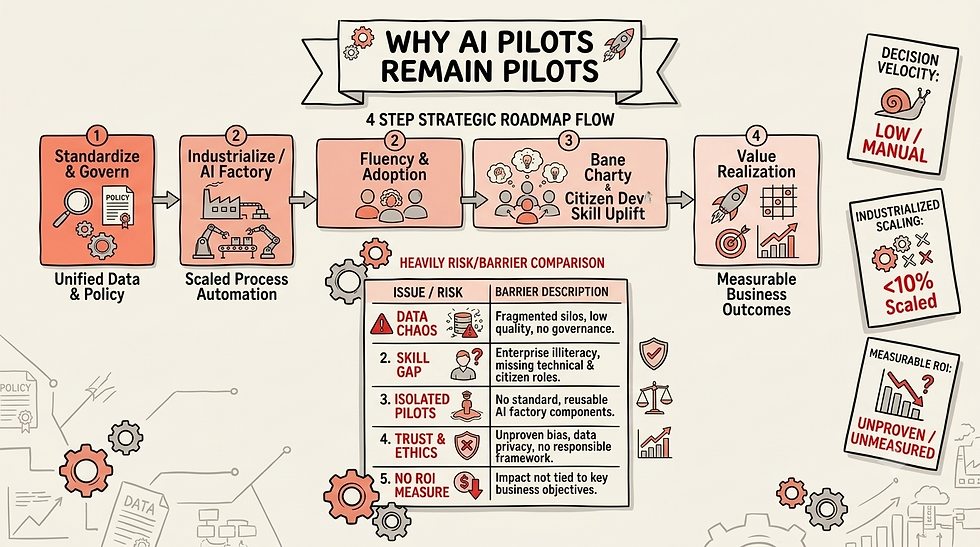
Across many enterprises, AI adoption has become fragmented. Different business units pursue different priorities. Governance evolves after solutions are deployed. Learning occurs inconsistently. Business outcomes are often anecdotal rather than measurable.
The result is what can best be described as AI noise.
AI noise is characterized by visible activity without a corresponding increase in organizational capability. It creates the appearance of transformation while leaving the operating model largely unchanged.
A Lesson from the Enterprise Frontline
Several years ago, one global enterprise found itself at the beginning of its AI journey.
Like many organizations, it had enthusiastic early adopters, isolated experiments, and a growing belief that artificial intelligence would become strategically important.
What it did not have was scale.
There was no common governance model.
No enterprise adoption framework.
No capability maturity model.
No consistent way to measure productivity gains.
AI existed largely as a collection of disconnected initiatives.
Today, that same organization has scaled AI to more than 71,000 employees, deployed over 170 production solutions, operationalized hundreds of use cases, and established measurable governance, adoption, and value realization mechanisms.
What changed was not access to technology.
What changed was the creation of enterprise capability.
The lesson is profound.
Technology initiated the journey.
Capability enabled the transformation.
Activity Is Not Capability
The distinction between AI noise and AI capability becomes clear when examined through an enterprise lens.
AI Noise | AI Capability |
Tool adoption | Enterprise capability |
Pilots | Enterprise scale |
Individual enthusiasts | Workforce transformation |
Local success stories | Repeatable business outcomes |
Activity metrics | Value metrics |
Innovation pockets | Institutionalized practices |
Technological experimentation | Operating model execution |
Many organizations focus their attention on the left side of the table.
The leaders emerging from the current wave of AI transformation focus relentlessly on the right.
Capability is not built through isolated successes. It is built through systems that allow success to be repeated.
Why Technology Alone Does Not Transform Organizations
Enterprise history provides a useful precedent.
Organizations did not become digital enterprises because they purchased ERP systems.
They became digital enterprises because they redesigned processes, governance structures, operating models, and workforce behaviors around those systems.
The same principle applies to AI.
A model can generate content.
A copilot can improve productivity.
An agent can automate tasks.
None of those developments automatically transform an enterprise.
Transformation occurs when technology becomes embedded within the way the organization operates.
This requires deliberate investment in governance, workforce readiness, delivery models, measurement frameworks, and change management.
Technology provides capability potential.
The operating model converts that potential into business value.
Unfortunately, many organizations stop at technology deployment and mistake that step for transformation.
The Missing Elements of Enterprise Capability
Organizations that successfully scale AI share several characteristics.
First, they establish governance before scale rather than after it.
Trust becomes a prerequisite for adoption. Risk management, compliance, responsible AI principles, and accountability are integrated into delivery processes rather than treated as separate activities.
Second, they invest in adoption as aggressively as they invest in technology.
Employees require more than access. They need fluency, confidence, support structures, communities of practice, and role-specific enablement.
Third, they industrialize delivery.
Rather than treating every use case as a unique project, they develop reusable patterns, common frameworks, and repeatable implementation mechanisms.
Finally, they measure value consistently.
The most advanced organizations assess productivity, quality, efficiency, cycle time reduction, workforce impact, and business outcomes. They move beyond activity metrics and focus on measurable value creation.
Together, these capabilities transform AI from an innovation initiative into an enterprise capability.
Capability Is the New Competitive Advantage
The current AI wave has created a dangerous assumption among business leaders.
Many believe that competitive differentiation comes from access to better technology.
History suggests otherwise.
Technology advantages rarely remain exclusive for long.
Models evolve rapidly.
New platforms emerge continuously.
Capabilities that appear unique today become commoditized tomorrow.
Organizational capability follows a different pattern.
Governance systems mature over time.
Workforce fluency compounds.
Adoption networks strengthen.
Delivery engines grow more efficient.
Measurement frameworks improve decision quality.
These capabilities are difficult to replicate because they become embedded within the institution itself.
As AI becomes more pervasive, enterprise advantage will increasingly depend not on what technology organizations own, but on how effectively they operationalize it.
The Shift Every CIO Must Make
For CIOs, this represents a significant leadership challenge.
The traditional technology question is:
"Which AI platform should we deploy?"
The more important transformation question is:
"What capability must we build to ensure AI continuously creates value?"
The first question focuses on technology. The second focuses on the enterprise.
The first delivers implementation. The second delivers transformation.
As AI becomes a permanent part of business strategy, the organizations that succeed will be those that recognize this distinction early.
They will invest in governance as deliberately as technology. They will treat adoption as seriously as deployment. They will measure outcomes instead of activity.
Most importantly, they will build capability rather than accumulate tools.
Conclusion
The AI conversation has entered a new phase. The initial race was about access. The emerging race is about operationalization.
Organizations that continue to measure success through tools, pilots, and experimentation will generate significant activity but limited transformation.
Organizations that focus on building enterprise capability will create something far more valuable: a repeatable system for turning intelligence into business outcomes.
The AI race is no longer about who acquires intelligence first.
It is about who operationalizes intelligence best.

Comments