The AI Operating System
A New Operating Model for the Intelligent Enterprise

Artificial intelligence has entered a new phase of enterprise adoption.
The first wave was defined by experimentation. Organizations explored models, tested copilots, launched pilots, and assessed emerging technologies. The second wave focused on deployment. Enterprises began rolling out AI capabilities across business functions, creating momentum and demonstrating value.
A third phase is now emerging.
It is no longer defined by models, platforms, or use cases.
It is defined by operating systems.
After scaling AI across more than 90,000 employees, enabling hundreds of use cases, deploying over 170 production solutions, and operationalizing dozens of AI agents, one lesson becomes unmistakably clear:
AI transformation is not fundamentally a technology problem. It is an operating model problem.
This realization represents a significant shift in how enterprise leaders should think about artificial intelligence. The organizations that dominate the next decade will not necessarily be those with access to the most advanced technology.
They will be those that build the strongest organizational capability for operationalizing intelligence at scale.
The Limits of Traditional Operating Models
Most enterprise operating models were designed for a different era.
They were built around applications, systems of record, business processes, and transactional workflows. The primary objective was standardization, predictability, and operational efficiency.
Artificial intelligence introduces an entirely different dynamic.
Unlike traditional systems, AI continuously generates insights, recommendations, content, decisions, and increasingly autonomous actions. Knowledge work becomes augmented. Decision making becomes assisted. Workflows become adaptive rather than static.
Organizations are no longer managing only processes. They are managing intelligence.
This distinction is critical because traditional operating models were not designed to govern, scale, and optimize intelligence as an enterprise capability.
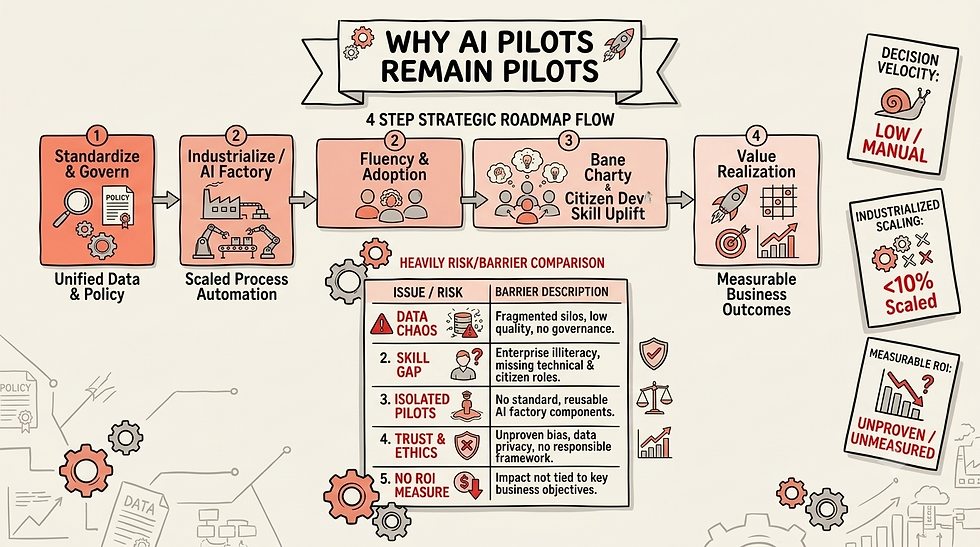
The result is increasingly visible across industries. AI adoption becomes fragmented. Governance struggles to keep pace. Successful pilots fail to scale. Workforce capability varies dramatically between functions. Business value remains difficult to measure consistently.
Technology is advancing rapidly. Organizational capability is not.
A new operating model is required.
From Technology Strategy to Capability Strategy
Historically, technology leaders asked questions such as:
Which platform should we deploy?
Which applications should we standardize?
Which infrastructure should we modernize?
While still important, these questions no longer address the central challenge of AI transformation.
The more important question is:
How does an enterprise build a repeatable capability for creating, governing, deploying, adopting, and measuring intelligence at scale?
The answer is what can be described as an AI Operating System.
An AI Operating System is not a software platform.
It is not a technology architecture.
It is an enterprise operating model designed to transform AI from a collection of initiatives into an institutional capability.
Like any operating system, its purpose is coordination.
It aligns governance, delivery, enablement, adoption, and measurement into a coherent enterprise framework.
At its core are five interconnected layers.
Layer One: The Access Layer
Every AI transformation begins with access.
Employees cannot derive value from capabilities they cannot use.
However, access is often misunderstood as a licensing problem. Enterprises frequently measure success by the number of users provisioned or tools deployed. These metrics reveal availability but say little about adoption or impact.
The Access Layer focuses on ensuring that the right AI capability reaches the right employee at the right time within the context of their work.
Knowledge workers, software engineers, service desk teams, finance professionals, HR specialists, and sales teams all require different forms of augmentation.
An effective Access Layer creates consistency across the enterprise while ensuring relevance at the individual level.
Without structured access, AI adoption becomes fragmented.
With structured access, adoption becomes scalable.
Layer Two: The Control Layer
As AI becomes integrated into business operations, trust becomes a strategic requirement.
Leaders often assume governance slows innovation. In practice, the opposite is true.
Organizations scale only when stakeholders trust the systems they are deploying.
The Control Layer establishes that trust.
It encompasses responsible AI principles, governance frameworks, risk management, security standards, compliance mechanisms, accountability structures, and decision rights.
Its purpose is not to restrict innovation.
Its purpose is to create conditions under which innovation can scale safely.
Without governance, AI adoption eventually encounters organizational resistance.
With governance, organizations develop the confidence required to expand adoption across business functions and geographies.
Trust enables scale.
The Control Layer institutionalizes trust.
Layer Three: The Factory Layer
Most organizations still approach AI development as a project.
Each use case is identified independently. Each solution is developed independently. Each deployment follows its own path.
This approach may support dozens of use cases.
It cannot efficiently support hundreds.
The Factory Layer introduces industrialization.
Its objective is to convert AI delivery from an artisanal activity into a repeatable production system.
Reusable components, shared patterns, standard delivery practices, common onboarding frameworks, predefined governance mechanisms, and scalable deployment processes become the foundation.
The impact is significant.
Delivery becomes faster.
Costs decline.
Quality improves.
Knowledge accumulates.
Organizations stop rebuilding the same capabilities repeatedly and instead begin scaling proven approaches.
The Factory Layer transforms AI from episodic innovation into operational execution.
Layer Four: The People Layer
Technology has always been the visible component of transformation. People have always been the determining component.
The greatest misconception surrounding AI transformation is that adoption occurs naturally once technology becomes available.
Experience suggests otherwise.
Employees must understand not only how AI works, but how work itself changes when intelligence becomes embedded within everyday activities.
The People Layer focuses on organizational readiness.
This includes AI fluency, role-based enablement, change management, leadership engagement, communities of practice, champion networks, experimentation forums, and continuous capability development.
The objective is not training.
The objective is behavioral transformation.
Training creates awareness.
Fluency creates confidence.
Confidence creates adoption.
Adoption creates outcomes.
The organizations achieving meaningful AI transformation recognize that workforce capability is not a supporting activity. It is a core component of the operating model itself.
Layer Five: The Value Layer
Every transformational technology ultimately arrives at the same question.
What value is being created?
The Value Layer exists to answer that question.
Many organizations collect activity metrics. They count licenses, prompts, chat sessions, experiments, and pilots. While useful, these measures provide limited insight into business impact.
The Value Layer focuses on outcomes.
Productivity improvements.
Process efficiency.
Workforce effectiveness.
Risk reduction.
Revenue acceleration.
Quality enhancement.
Business performance.
By connecting AI activity to measurable organizational outcomes, leaders gain the visibility required to make informed investment decisions.
The Value Layer transforms AI from an expense category into a strategic business capability.
Why the Layers Must Work Together
The greatest mistake organizations make is treating these capabilities as independent initiatives.
Governance teams build controls. Technology teams deploy platforms. Learning teams create training.
Innovation groups develop use cases. Finance leaders measure returns. Each function performs its role effectively.
Yet transformation remains elusive.
The reason is simple.
AI capability emerges not from individual layers but from their integration.
Access drives adoption.
Control creates trust.
Factory enables scale.
People transform behavior.
Value proves impact.
Remove any layer and enterprise transformation weakens.
Strengthen the connections between them and AI evolves from localized innovation into institutional capability.
This integration is what differentiates an AI Operating System from a collection of disconnected programs.
A New Agenda for Boards and CIOs
For boards, the implications are profound.
Many organizations still evaluate AI maturity through indicators such as use case counts, pilot volumes, platform deployments, and technology investments.
These measures provide useful signals but incomplete insight.
A more important set of questions is emerging:
Do we have an AI operating model?
Is governance integrated into delivery?
Can successful solutions be replicated consistently?
Is workforce capability keeping pace with technological change?
Can we measure business value across the enterprise?
The answers to these questions reveal far more about long-term AI readiness than counts of licenses or pilots.
For CIOs, the mandate is equally clear.
Their responsibility is expanding beyond technology deployment toward capability design.
The challenge is no longer selecting the right tools.
The challenge is creating the organizational mechanisms required to operationalize intelligence across the enterprise.
The Next Competitive Advantage
The first phase of AI was about models.
The second phase was about copilots.
The third phase will be about operating systems.
Enterprises that build an AI Operating System will transform AI from a technology initiative into an organizational capability. They will create governance that scales, workforces that adapt, delivery engines that industrialize innovation, and measurement systems that connect intelligence directly to business value.
Those that do not will continue to run pilots while their competitors build intelligence into the fabric of how the enterprise operates.
In the coming decade, that distinction may become the defining competitive advantage of the intelligent enterprise.

Comments